
Ratings and levels: how Flobit measures your game
In short
Flobit gives you three separate numbers. Your level is what you say you are: 1.0 to 7.0 in tennis and padel, Beginner to Advanced in other sports. Your rating is an ELO score for each sport. It starts from your level and moves only when confirmed results come in. Your sportsmanship score is the 1 to 5 stars your opponents give you.
What is the difference between a level and a rating?
A level is a description you choose; a rating is a number your results earn. You pick a level for each sport when you add it to your profile, and other players can see it. You can change it any time, and changing it never moves your rating.
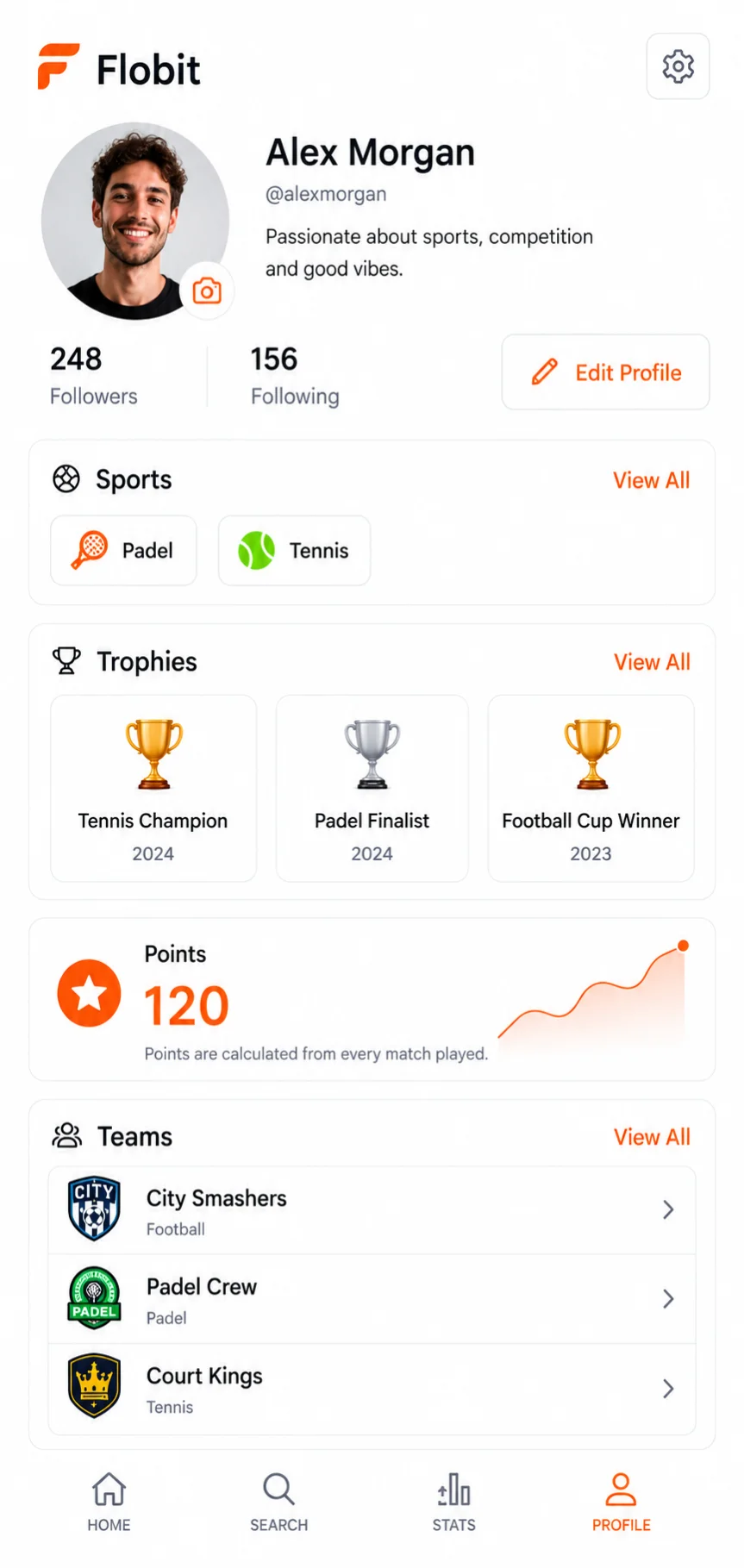
The rating is an ELO score kept separately for every sport. Nobody sets it by hand: it starts from your declared level once, when you add the sport, and after that only matches change it. Your rating appears in Profile, under My sports, next to your matches played.
The two can disagree, and that is fine. A newcomer who plays well can rate above their level, and someone who declared too high will see the rating settle lower. A third number, your sportsmanship score, is separate again and has nothing to do with winning.
What rating do I start with?
You start between 900 and 1500, depending on the level you declare, or at 1000 if you declare none.
| Declared level | Starting rating |
|---|---|
| Beginner | 900 |
| Intermediate | 1100 |
| Advanced | 1300 |
| No level declared | 1000 |
Tennis and padel use a finer ladder, from 1.0 to 7.0 in half-point steps, and each half-point is worth 50 rating points: 1.0 starts at 900, 2.0 at 1000, 3.0 at 1100, 4.0 at 1200, 5.0 at 1300, 6.0 at 1400 and 7.0 at 1500. Tennis wording follows the USTA's NTRP and padel wording follows the LTA's padel ratings. The padel levels guide and the tennis levels guide help you pick honestly.
For other sports the app offers Beginner, Intermediate and Advanced. A starting rating is a guess; the first ten matches correct it quickly.
How does my rating change after a match?
Your rating changes when a result is confirmed. A win raises it and a loss lowers it, by more when you beat a stronger opponent and by less when you beat a weaker one. It is the standard ELO formula, with the expected score based on the gap between ratings.
How much it can move is set by a "K" number:
| Your matches in that sport | Casual match (Quick or open) | Tournament match |
|---|---|---|
| First 10 | 40 | 40 |
| After 10 | 24 | 32 |
Two players rated 1100 who meet in an established casual match swing 12 points each way. In your first 10 matches the same match swings 20. If a 1100 player beats a 1300 player, they gain about 18 points; if the 1300 player wins, they gain about 6.
- Doubles. Each player is compared with the average rating of the two opponents.
- Guests. A guest is treated as a player rated 1000, and has no rating of their own.
- Referees aren't rated, and a retirement counts as a win for the other side.
- Disputes. If a result is disputed, the rating changes it caused are taken back. If the dispute is not resolved within 24 hours, the original result stands again.
- Team entries. Matches between registered teams don't change anyone's personal rating.
Results confirm when a player confirms the score, or automatically 24 hours after the score is submitted.
What is the sportsmanship rating?
It is a separate score from 1 to 5 stars that your opponents give you after a match, for turning up, fair play and good spirit, and not for how well you played. You can only rate someone you played against in a finished match that isn't under dispute, not a teammate, and guests can't be rated. There are no written comments.
- Editable for 48 hours. After you send a rating you can change it for 48 hours, and then it locks.
- Not one bad night. The number shown is pulled toward the average of all players while you have few ratings, so a single 1-star doesn't define you. If you rate the same person after many matches, your votes are averaged into one.
- You can hide yours. In Settings, under Privacy, switch off "Show on my profile" in the Sportsmanship section and other players don't see your average or how many ratings you have. You still see it.
Other players can see your score on your profile unless you hide it, which is why it is worth a thoughtful tap.
Where do levels and ratings matter in Flobit?
Mostly as a guide for people choosing who to play with. None of it blocks you from joining a game on its own.
- Open matches. A host can set a level range, shown on the listing. The host approves every request. See open matches.
- Daily digest. Flobit uses your rating to decide which open matches fit when it counts them for your daily digest.
- Tournaments. An organizer can suggest levels. They show players the intended standard, and anyone can still enter.
- Mexicano. To balance partners, the organizer rates each player from 1 to 5 before the draw. That is the organizer's own number, not your ELO.
- Fair teams. Ratings help when you split a group evenly; see how to make fair teams.
Flobit does not seed tournament brackets by rating, and it has no city, national or global rankings. Your rating is for you and your opponents to compare.
Is it the same as Playtomic levels, NTRP or UTR?
No. Each system is built differently, and there is no official conversion between them.
| Flobit | NTRP | Playtomic | UTR | |
|---|---|---|---|---|
| Scale | Level 1.0 to 7.0 or Beginner to Advanced; rating about 900 to 1500 at the start | 1.5 to 7.0 in half-points | 0 to 7 | 1.00 to 16.50 |
| How you get it | You declare a level; your rating comes from results | A self-rating questionnaire, then a computer rating after league matches | Calculated from your results and your opponents' levels | Calculated from match results, using up to 30 recent matches |
NTRP is run by the USTA, Playtomic is a court-booking app and UTR is run by UTR Sports. If a club asks for one of those numbers, give it that one. The padel levels guide and tennis levels guide compare the descriptions.
Frequently asked questions
Can my rating go down after a win?
No. In ELO a win always raises your rating, because you are expected to win less than 100% of the time. Beating a much weaker opponent adds only a fraction of a point, while beating a stronger one adds more. A loss always lowers it.
Why did my rating move so much at first?
For your first 10 matches in a sport, each result can move your rating by up to 40 points at an even match, instead of 24 after that. The bigger swings let a rating settle near your real level quickly, and then it stabilizes.
Do casual matches count towards my rating?
Yes. A confirmed Quick Match or open match changes your rating, with a K of 24 once you have played 10 matches in the sport. Tournament matches count a little more, with a K of 32. A cancelled match doesn't count.
Can I hide my sportsmanship rating?
Yes. In Settings, under Privacy, switch off "Show on my profile" in the Sportsmanship section. Other players then can't see your average or how many ratings you have. You can still see it yourself, and you can still rate others.
Does changing my level change my rating?
No. Your declared level sets your starting rating once, when you add the sport. After that you can change the level whenever you like, and it only changes what other players see. Your rating changes only through confirmed matches.
Is a Flobit rating the same as a Playtomic level, NTRP or UTR?
No. They use different scales and different calculations, and no official conversion exists. Flobit's rating is an ELO number that starts near 900 to 1500. Use the system that the club or event asks for when it asks for a number.
Who can rate my sportsmanship?
Only players who played against you in a finished match that isn't under dispute. Teammates can't rate each other, guests have no account to rate or be rated, and there are no written comments. Each rating can be changed for 48 hours.
Sources
Play more. Get better.
Free on iPhone and on the web. No ads, no subscription.
Already have an account? Sign in